School Transport Management: Routes, Fares and Child Safety
For many families in Pakistan, the school van or bus is the deciding factor in choosing a school. It is also one of the most difficult services to manage: routes change, drivers change, fares differ by distance, and a single late or unsafe trip can cost a school its good name. Yet in many schools, transport is still run from a register and a driver’s memory.
This guide explains how to organise school transport properly, from routes and fares to safety and parent communication, and how a school management system makes it manageable.
Plan routes and stops on paper first
Start by listing every area your students come from and grouping them into routes that a vehicle can complete within a reasonable time. For each route, record:
- The stops in order, with an approximate pick-up and drop-off time for each.
- The vehicle assigned and its seating capacity.
- The driver and, where you have one, the attendant or conductor.
Keep the longest ride for the youngest children as short as possible, and review routes at the start of every session and whenever a new housing area starts sending students.
Keep vehicle and driver records complete
Parents will ask, and in an incident so will the authorities. For every vehicle and driver, keep:
- Vehicle registration, fitness and route permit details, and insurance, with expiry dates.
- Driver’s name, CNIC, driving licence with expiry date, phone number and emergency contact.
- Attendant details where applicable.
Expired documents are the easiest problem to prevent and the most embarrassing to explain. A system that stores these records in one place makes the monthly check quick.
Charge transport fees fairly and automatically
Transport fee disputes usually come from inconsistency: two neighbours paying different amounts, or a fare still charged after a student stopped using the van. A clear approach:
- Set the fare by route or stop, so distance decides the price.
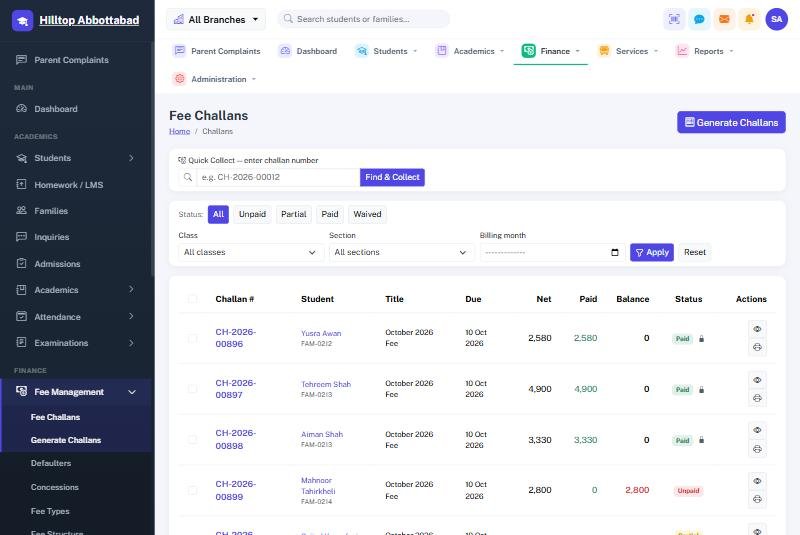
- Assign each student to a route and stop; the transport fare then appears automatically on that student’s monthly challan.
- When a student joins or leaves transport, update the assignment once, and the next challan is correct.
- Apply any sibling or staff-child transport concession by rule, not by hand.
Because transport is just another line on the challan, it is collected, receipted and reported with the rest of the fee, and appears in the defaulters list if unpaid. (See our plan to reduce fee defaulters.)
Know who is on every vehicle
At any moment, the office should be able to print or open the list of students on each route, with their stop, class and parents’ phone numbers. Give a copy to every driver and attendant, and update it whenever a student is added or removed. This simple list is invaluable when a van breaks down, roads are closed, or a parent calls to ask where their child is.
Safety rules every school should follow
- Never exceed the vehicle’s seating capacity.
- Have an adult attendant on vehicles carrying young children.
- Hand younger children only to a known parent or authorised person at the stop.
- Keep a first-aid kit and the school’s emergency numbers in every vehicle.
- Check driver behaviour regularly, including speed and mobile phone use, and act on complaints.
- Make sure every child reaches home: no student should be left on the vehicle at the end of a route.
Keep parents informed
Most transport complaints are really communication problems. Tell parents the route, the stop, the expected times and the driver’s contact at the start of the session. When something changes, such as a new driver, a route change, a delay because of traffic or weather, or a holiday timing, send an SMS or app notification to the families on that route only. Gate attendance or biometric entry tells parents their child has arrived safely at school; see RFID gate attendance and SMS alerts.
Give parents an easy way to report a transport concern, and make sure the principal sees it. A complaint handled in a day protects the school’s reputation far better than one that reaches a WhatsApp group first.
How School Smart ERP helps
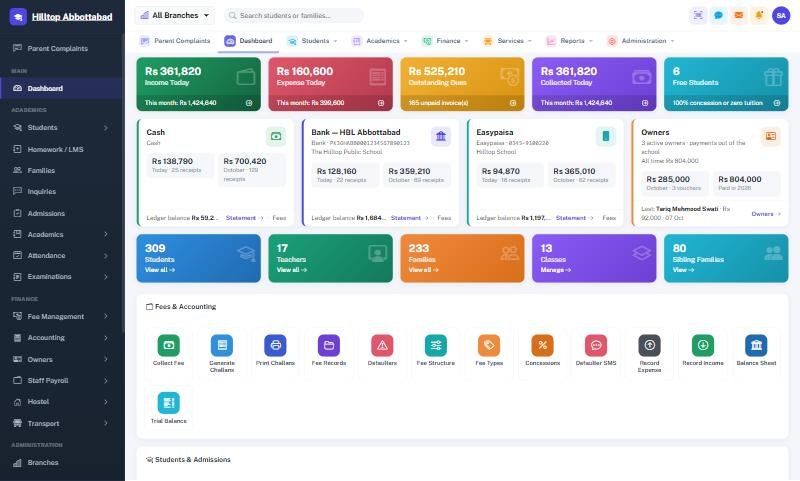
School Smart ERP includes a dedicated transport module: routes and stops, vehicles and drivers with their details, and student assignment to a route and stop. The student’s transport fare is added to the monthly fee challan automatically, so it is collected, receipted and tracked with the rest of the fee. Route-wise student lists, targeted SMS to the families on a route, and parent app notifications keep everyone informed.
Want to see transport, fees and parent communication working together? Book a free demo of School Smart ERP.
Frequently asked questions
What is a school transport management system?
It is software that records school vehicles, drivers, routes and stops, assigns each student to a route and stop, adds the transport fare to the student’s fee challan, and lets the school communicate with families on a specific route.
How should schools charge transport fees?
Set the fare by route or stop so that distance decides the price, assign each student to a stop, and let the transport fare appear automatically on the monthly challan. Update the assignment when a student joins or leaves transport.
What records should a school keep for vans and drivers?
Vehicle registration, fitness, route permit and insurance with expiry dates, and for each driver their CNIC, driving licence with expiry date, phone number and emergency contact, plus attendant details where applicable.
How can schools keep parents informed about transport?
Share the route, stop, timings and driver contact at the start of the session, and send an SMS or app notification to the families on a route whenever there is a change or a delay.
Run your school the smart way
Book a free demo of School Smart ERP for your school or college.
Request a Free Demo